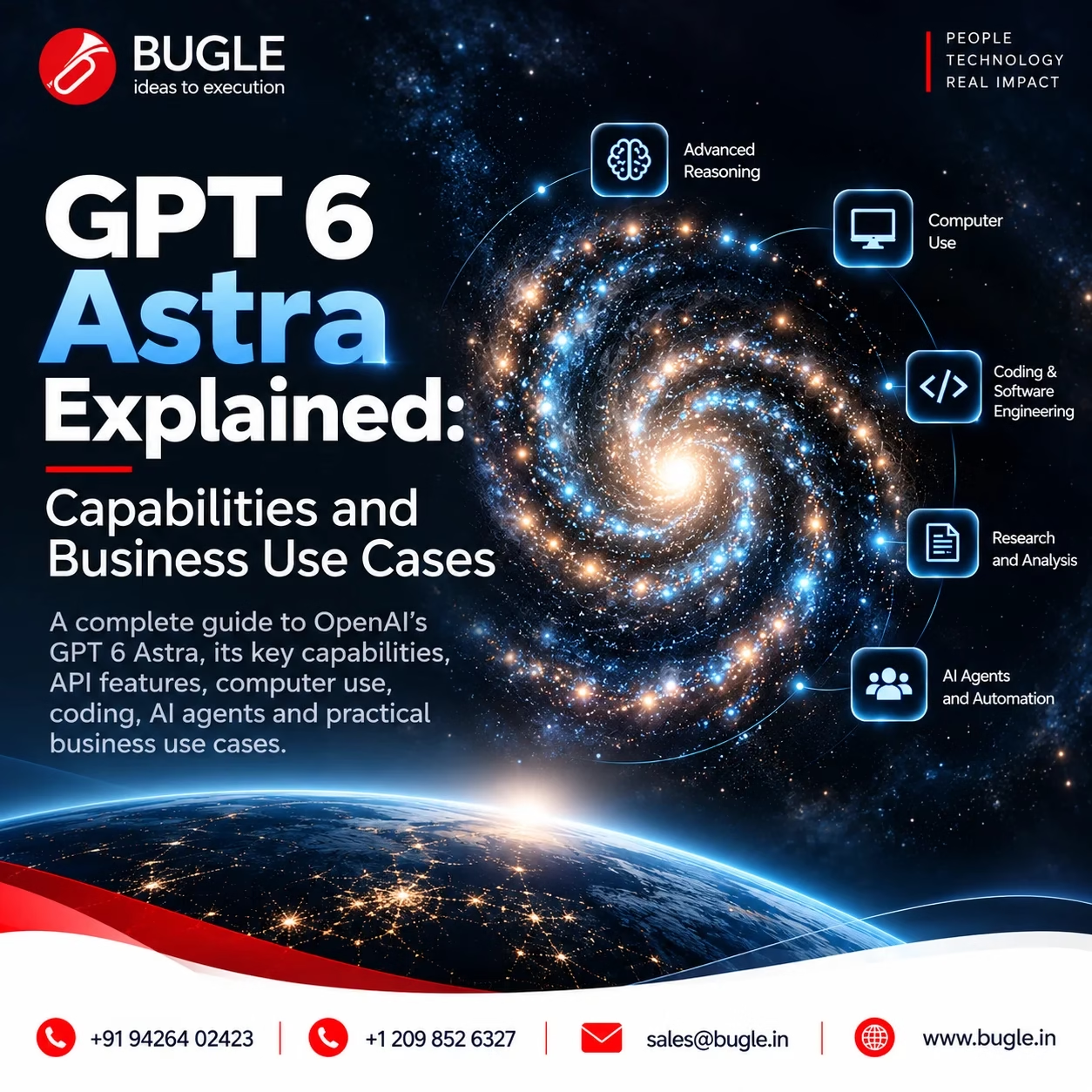

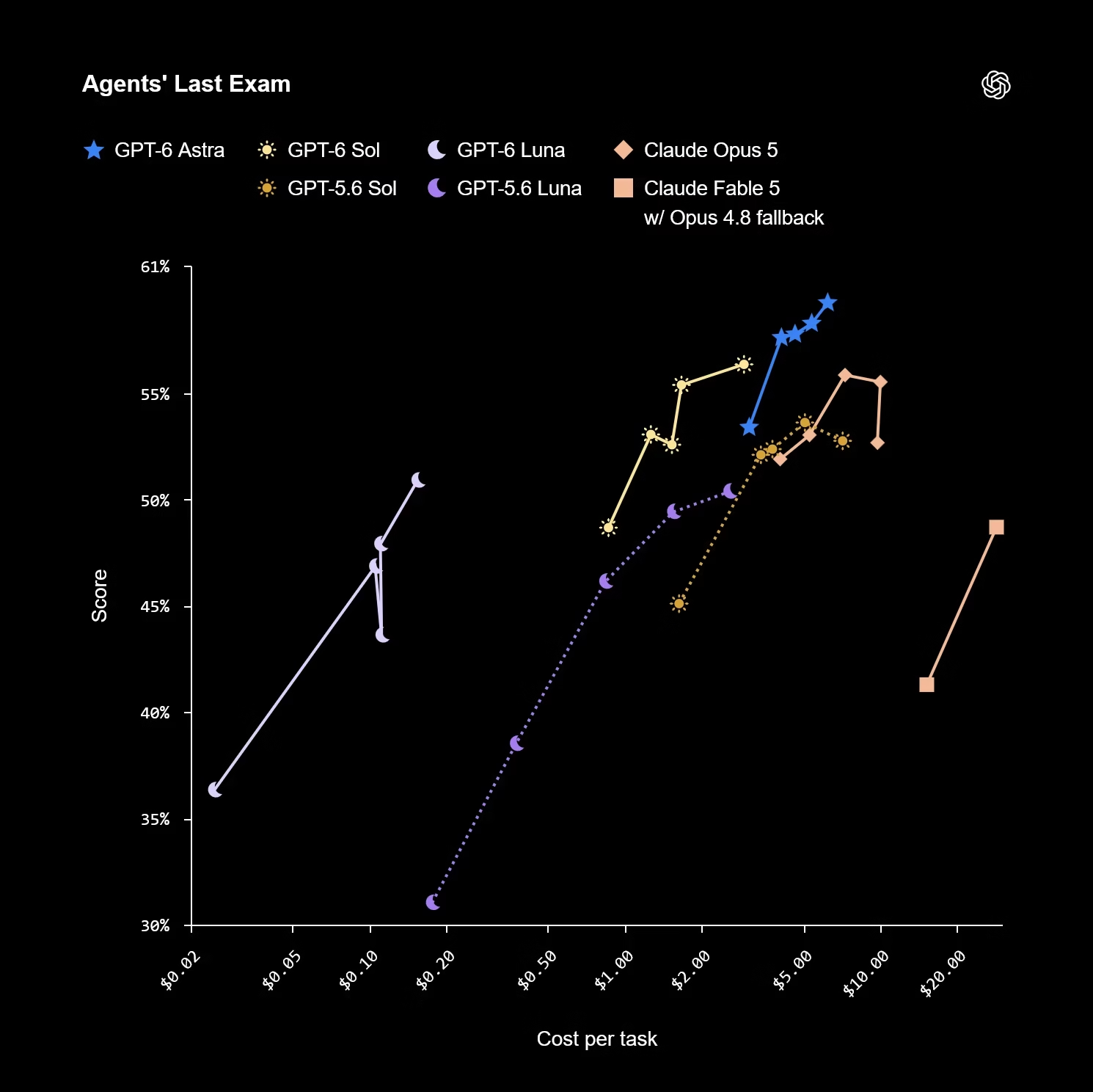
GPT 6 Astra is OpenAI’s latest frontier AI model, designed to move beyond simple question answering and content generation toward complex reasoning, computer use, software engineering, research, cybersecurity and professional workflows. OpenAI describes Astra as its most capable broadly deployed model and reports state of the art performance in areas including computer use, browsing, software engineering, science, professional work and cybersecurity.
The important development is not only that Astra can produce better answers. The model is designed to understand a goal, work through multiple steps, interact with software and tools, process large amounts of information and produce usable outputs such as documents, spreadsheets, presentations and analyses.
For businesses, this changes the role of AI. Instead of using an AI model only as a writing assistant or chatbot, organizations can connect it to applications, business data and workflows to support more complete tasks.
OpenAI’s rollout includes availability through its own ecosystem and the API, while Microsoft has made GPT 6 Astra generally available through Microsoft Foundry and AWS has made it generally available through Amazon Bedrock.
What Is GPT 6 Astra?
GPT 6 Astra is a multimodal reasoning model from OpenAI built for advanced professional and technical workloads.
At a practical level, the model combines several capabilities:
- Advanced reasoning
- Long context processing
- Computer and browser interaction
- Software engineering
- Tool and function use
- Research and analysis
- Professional document generation
- AI agent workflows
- Cybersecurity capabilities
- Enterprise application interaction
According to Microsoft’s current Foundry documentation, the model supports reasoning, the Responses API, multi agent orchestration in preview, Chat Completions, streaming, structured outputs, functions, tools, parallel tool calling through the Responses API, adjustable reasoning effort, adjustable verbosity and computer use. It supports text and image input with text output. The documented context window is 1,050,000 tokens, including up to 922,000 input tokens and 128,000 output tokens.
That large context capacity is particularly relevant to enterprise applications where the AI may need to work with long documents, large codebases, detailed research material or several sources of business information in one workflow.
Why GPT 6 Astra Matters for Businesses?
The major difference with GPT 6 Astra is its orientation toward work rather than isolated conversations.
OpenAI says Astra is specifically trained for professional environments and can produce documents, spreadsheets, presentations and analyses that follow existing templates, standards and visual or writing styles. It can also use computer interaction to perform tasks across applications.
Microsoft describes this shift as moving from conversational assistance toward larger units of work. Its examples include software engineering, business intelligence, document creation, customer record updates, form processing and website testing.
This creates a new implementation model:
Business goal → reasoning → information retrieval → tool use → action → verification → human review
That workflow is much closer to business automation than traditional generative AI.
Key GPT 6 Astra Capabilities
Advanced Reasoning and Decision Support
Astra is designed for tasks where the answer depends on several pieces of information and tradeoffs rather than a single straightforward instruction.
A business analyst could provide financial data, customer information and operational constraints and ask the model to identify patterns, compare options and prepare a recommendation.
The model can also incorporate additional instructions as a task changes. OpenAI says Astra is better at maintaining the broader task context while responding to new requirements rather than treating every new instruction as an entirely separate objective.
This makes reasoning particularly relevant to planning, research, operations and decision support.
Large Context Window
Astra’s documented context window reaches 1,050,000 tokens.
For businesses, this can matter when working with large information sets such as:
- Annual reports
- Contracts
- Technical documentation
- Product specifications
- Research papers
- Software repositories
- Support histories
- Internal knowledge bases
A large context does not automatically guarantee accurate results, but it gives developers significantly more room to provide relevant information to a model within one workflow.
Computer and Browser Use
One of the most important GPT 6 Astra capabilities is computer use.
OpenAI and Microsoft describe Astra as capable of interacting with applications and interfaces, including workflows where a dedicated API may not exist. Microsoft gives examples such as updating records, navigating development tools, testing software and assembling information into reports.
This makes computer use particularly interesting for legacy environments and business systems that were not originally designed for AI integration.
Instead of asking an employee to manually move information from one system to another, an agent built around Astra could potentially perform approved actions through the user interface.
Software Engineering
OpenAI positions Astra as a major step forward for software engineering.
The model can support coding, debugging, repository analysis, testing and development tasks. Microsoft reports enterprise scenarios including reproducing complex bugs, investigating causes, proposing fixes and preparing changes for developer review.
This does not remove the need for software engineers. Instead, it can shift developer time toward architecture, system design, verification and higher value engineering decisions.
Professional Output
Another differentiator is output quality for business artifacts.
OpenAI states that Astra is trained to work with existing templates and produce documents, presentations, spreadsheets and analyses that align with organizational standards.
That opens applications in consulting, finance, marketing, sales operations and management reporting.
GPT 6 Astra API for Developers
Developers can use GPT 6 Astra API capabilities to build AI powered applications and agents instead of using Astra only through a conversational interface.
The documented model capabilities include the Responses API, structured outputs, function and tool calling, streaming, computer use and parallel tool calling through the Responses API.
This provides the components needed to build systems where the model can reason and then interact with external software.
For example, a lead management application could follow this workflow:
Website enquiry → Astra reads the enquiry → retrieves customer information → evaluates the lead → calls the CRM API → assigns the lead → prepares follow up communication → requests approval for sending.
That is an AI workflow rather than a standalone chatbot.
For businesses planning this type of architecture, Bugle’s LLM Integration Services focus on connecting large language models with websites, CRMs, ERPs, databases, knowledge bases and internal workflows.
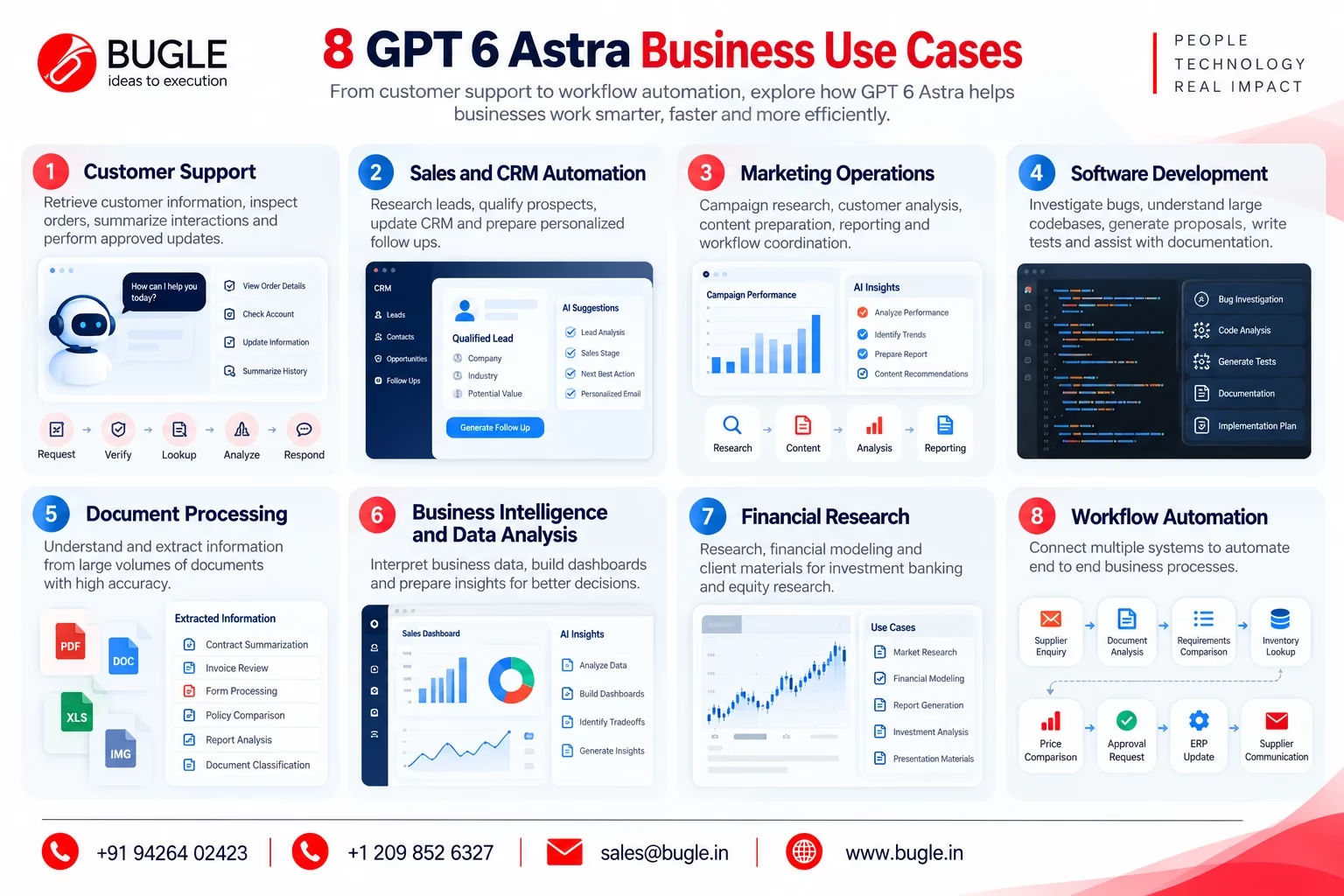
8 GPT 6 Astra Business Use Cases
1. Customer Support
Customer support is one of the clearest applications for GPT 6 Astra in business.
Instead of answering only frequently asked questions, an AI agent can potentially retrieve customer information, inspect an order, summarize previous interactions and perform approved updates.
A support workflow could look like:
Customer request → identity verification → account lookup → issue analysis → knowledge retrieval → action → response → CRM update.
Human agents can remain involved in escalations and sensitive cases.
2. Sales and CRM Automation
Sales teams can use Astra for research, qualification, CRM updates and personalized follow up.
For example, an AI agent could review an incoming lead, compare it with company criteria, retrieve previous CRM interactions, identify the appropriate sales stage and prepare a follow up.
The model’s ability to use tools is important here because the value comes from connecting reasoning to the CRM rather than simply generating a sales email.
3. Marketing Operations
Marketing teams can use GPT 6 Astra for campaign research, customer analysis, content preparation, reporting and workflow coordination.
Astra could analyze campaign information, review performance data and prepare a structured report for a marketing manager.
Human approval can remain part of publication workflows, especially where content involves pricing, claims, legal requirements or brand sensitive information.
4. Software Development
Software development is another major use case.
Teams can use Astra to investigate bugs, understand large codebases, generate implementation proposals, write tests and assist with documentation.
Microsoft specifically cites scenarios involving bug reproduction, root cause investigation and preparation of changes for developer review.
The most useful implementation is often not “AI writes all the code.” It is an AI engineering workflow where the model handles repetitive investigation while developers retain control over architecture and production decisions.
5. Document Processing
Businesses process thousands of documents across finance, operations, legal, procurement and administration.
With image and text input plus long context capabilities, Astra can be used in workflows involving document understanding and information extraction.
Possible applications include:
- Contract summarization
- Invoice review
- Form processing
- Policy comparison
- Report analysis
- Document classification
- Information extraction
Document Processing and Data Extraction can complement model based workflows by connecting AI with enterprise document pipelines.
6. Business Intelligence and Data Analysis
Astra can support analysts by helping interpret business data and prepare insights.
Microsoft describes an enterprise scenario in which Astra can build and refine dashboards in Power BI and help analysts compare data, identify tradeoffs and prepare insights for communication.
This can be especially valuable when combined with strong data foundations.
Bugle’s Data and Analytics Strategy covers data architecture, governance, dashboards, predictive analytics, cloud data platforms and AI enablement.
7. Financial Research
Astra is already being positioned for specialized financial work.
OpenAI launched ChatGPT for Financial Services with GPT 6 Astra reasoning, built in financial data and integrations for research, financial modeling and client materials. OpenAI says the product was developed with Morgan Stanley and Evercore and includes sources such as Daloopa, PitchBook and LSEG News.
Reuters also reported that the product is designed for investment banking and equity research workflows, including research, financial models and presentation material.
This is an important example of how frontier models are moving into specialized enterprise environments rather than remaining general purpose assistants.
8. Workflow Automation
The broader opportunity is connecting Astra with multiple systems.
Consider a procurement workflow:
Supplier enquiry → document analysis → requirements comparison → inventory lookup → price comparison → approval request → ERP update → supplier communication.
Astra could provide reasoning and natural language understanding, while APIs, databases and workflow systems perform deterministic operations.
Bugle’s AI Agent Development capabilities include tool and API integration, workflow automation, multi agent orchestration and secure deployment.
GPT 6 Astra and AI Agents
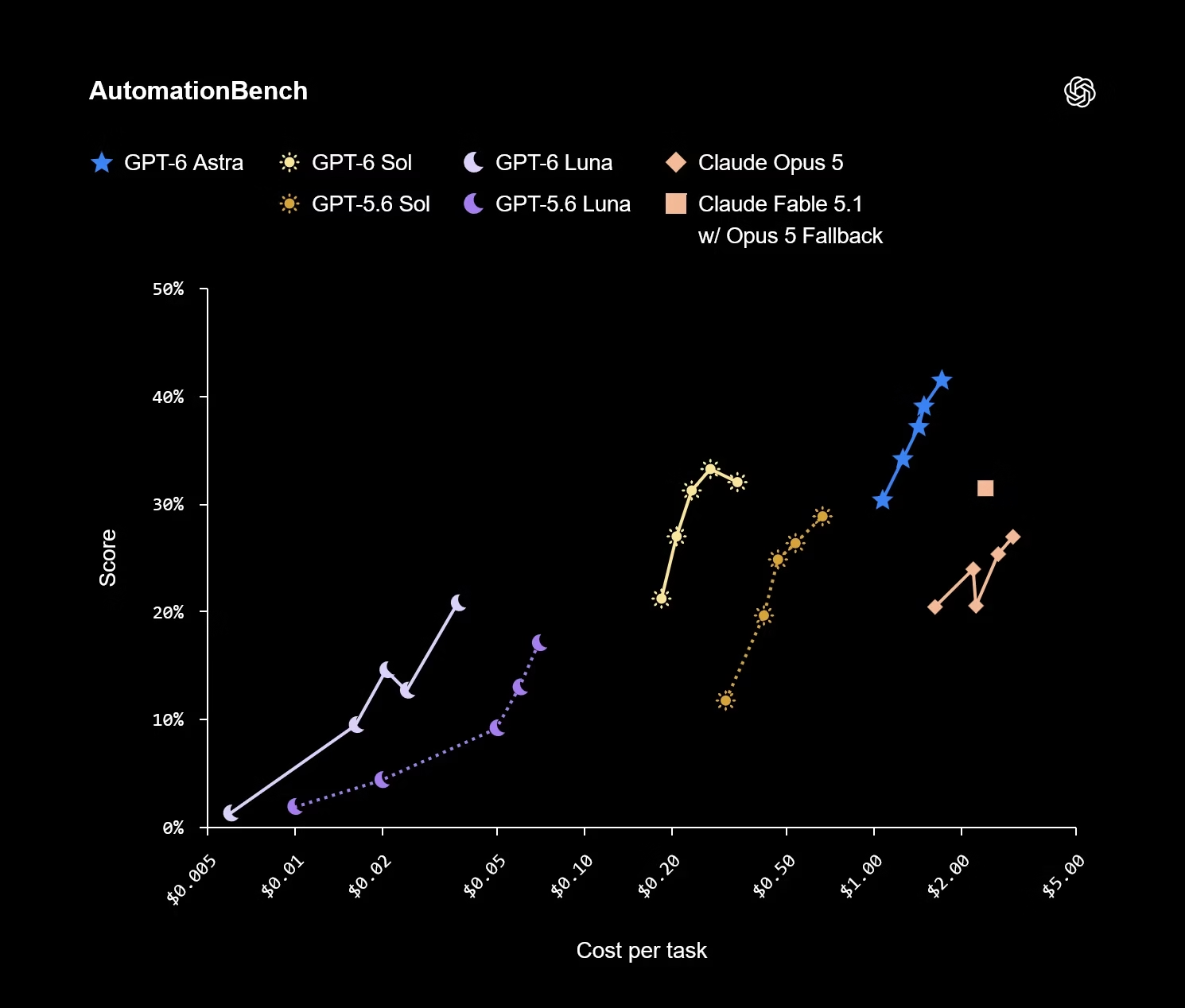
The rise of Astra is closely connected to the rise of AI agents in business.
An AI agent needs more than a language model. It needs access to information, tools, permissions, memory or state, workflow logic and monitoring.
Astra can serve as the reasoning engine within that architecture.
A simplified system might look like:
- User Goal
- GPT 6 Astra
- Planning and Reasoning
- Business Data and Knowledge
- Tools and APIs
- CRM, ERP, Database or Application
- Action
- Verification and Human Approval
This architecture is one reason agent development is becoming a major enterprise AI direction.
Microsoft describes Astra’s computer use and tool use as capabilities for completing multi step tasks across business applications, while OpenAI’s launch material emphasizes longer workflows and professional work.
For organizations building such systems, Bugle’s Custom AI Agent Development can be used to design, integrate, test, deploy and optimize business focused agents.
GPT 6 Astra Security and Limitations
Greater autonomy also introduces greater risk.
OpenAI’s safety assessment says GPT 6 Astra is the first OpenAI model to reach the Critical level of cybersecurity capability under its Preparedness Framework. OpenAI says that, with the right tools and access, Astra can identify previously unknown security flaws and develop exploitation methods without a person guiding every step.
For businesses, that capability reinforces the importance of controlled deployment.
AI agents should not automatically receive unrestricted access to:
- Customer records
- Financial systems
- Production infrastructure
- Sensitive documents
- Administrative controls
A stronger enterprise architecture uses scoped permissions, logging, monitoring, approval gates and clear separation between reasoning and high impact actions.
Microsoft similarly emphasizes scoped credentials, approved resources, human checkpoints and activity records for agentic workflows.
Astra can also make mistakes. A large context window does not remove hallucinations, data quality problems or incorrect reasoning. Organizations should validate important outputs and design workflows around measurable evaluation criteria.
GPT 6 Astra on Microsoft Foundry and Amazon Bedrock
Enterprise adoption is also becoming easier because Astra is available through major cloud platforms.
Microsoft announced GPT 6 Astra as generally available through Microsoft Foundry. It supports Standard and Provisioned Throughput deployment options, allowing organizations to select different approaches for variable workloads and more predictable capacity.
AWS announced general availability of GPT 6 Astra on Amazon Bedrock on September 8, 2026. AWS highlights use cases including autonomous agents, extensive document analysis, complex software investigations and application development.
This means companies can increasingly evaluate Astra within the cloud and enterprise environments they already use rather than creating an entirely separate AI infrastructure layer.
For implementation, infrastructure planning matters as much as model selection. Bugle’s wider technology services include Business and Technology Consulting, allowing AI initiatives to be evaluated alongside business processes, technology architecture and operational requirements.
How Businesses Should Start With GPT 6 Astra
Businesses should not begin with the question:
- "Where can we put AI?"
- A better question is:
- "Which business workflow has enough complexity, repetition and measurable value to benefit from AI?"
- A practical implementation approach is:
- Identify the workflow
- Choose a process with a clear beginning, end and measurable outcome.
- Map the systems
- Identify the CRM, ERP, databases, documents, APIs and applications involved.
- Separate reasoning from rules
- Use Astra for tasks involving interpretation, language and contextual reasoning. Use traditional software logic for deterministic operations where appropriate.
- Establish access controls
- Give the agent only the permissions required for its task.
- Add human approval
- Consequential actions should include an appropriate review step.
- Measure performance
- Track accuracy, task completion, latency, cost, failure rates and business outcomes.
- Expand gradually
- Start with one workflow and use the results to determine whether additional processes should be automated.
This approach also aligns with the need for strong data foundations. Bugle’s Predictive Analytics and Machine Learning Services can support organizations that need predictive models, anomaly detection, forecasting and broader AI systems alongside generative AI.
How Bugle Technologies Can Help With GPT 6 Astra?
GPT 6 Astra is most useful when it becomes part of a larger business system.
Bugle Technologies can help organizations move from model evaluation to practical implementation through AI agent development, LLM integration, data strategy and technology consulting.
Its Integrate Leading LLMs Into Business Workflows focus on connecting models such as OpenAI, Claude, Gemini and DeepSeek with business applications, websites, CRMs, ERPs and internal workflows.
For agent based applications,Build Intelligent AI Agents for Business Automation cover agent architecture, tool integration, workflow execution, multi agent systems, context management, security and monitoring.
Organizations that need to establish the data layer can use Build Strong Data Foundations for AI and Analytics for data architecture, governance, analytics and AI enablement.
The result is a more complete architecture in which the model is connected to reliable data, approved tools and measurable business workflows.
Frequently Asked Questions About GPT 6 Astra
GPT 6 Astra is OpenAI’s latest frontier AI model designed for advanced reasoning, computer use, software engineering, cybersecurity, research and professional work.
GPT 6 Astra can handle reasoning tasks, software engineering, computer use, long context analysis, tool based workflows and professional content such as documents, spreadsheets and presentations.
Microsoft and AWS documentation currently list a context window of 1,050,000 tokens, with up to 128,000 output tokens.
Yes. GPT 6 Astra is available through OpenAI’s API, and current platform documentation includes the Responses API, Chat Completions, tool use, structured outputs and other developer capabilities.
Yes. Its reasoning, tool use, function calling and computer use capabilities make it suitable for agent based architectures where an AI system needs to plan and execute multi step workflows. Microsoft also documents multi agent orchestration support in preview.
Yes. OpenAI and Microsoft describe software engineering as a core capability, including bug investigation, debugging, code work and software testing.
It can be deployed with enterprise security controls, but security depends heavily on the architecture, permissions, data handling, monitoring and governance surrounding the model. OpenAI has also designated Astra at the Critical cybersecurity capability level, making safeguards particularly important.
Yes. Its computer use, tool calling and integration capabilities allow developers to connect it with approved business applications and workflows. Microsoft specifically describes scenarios involving customer records, development tools, websites and business intelligence systems.